The Real Reason You're Not Making More Music (It's Not What You Think)
A conversation with a fellow musician that turned into something worth sharing.
A musician friend of mine — let's call him Gary, because that's his name — reached out recently with a question I think many of us have:
"Honestly, it's not really a creativity problem. Or a 'how to do it' problem. I've been doing this my whole life from many different angles. I understand a myriad of processes and don't feel I'm lacking ideas or enough skills. It's more of a need to carve time consistently and just allow the creativity to happen... My plate is always full. There never seems to be enough time to fit in the solitude I need to create things for myself. Any further thoughts there on time management for a dude like me? "
Gary is the kind of guy who has more skills, instincts, and musical vocabulary than most people spend a lifetime chasing. And yet — time is often the catchall reason we don’t pursue what’s important to us. I took time to write Gary a reply and I felt like it would help more people if I shared it in this post:
Skills Aren't the Problem
For a lot of creative people — especially musicians with serious experience — the bottleneck isn't skill. It isn't even inspiration. It's time. Or more accurately: the feeling that time isn't there.
We all have the same 24 hours. That's the uncomfortable truth I find myself coming back to. It's not a judgment. It's just... math.
The hard follow-up question — the one nobody wants to hear — is this:
Do we make time for what's actually most important to us?
Sometimes just sitting with that question is enough to rattle something loose.
The Time Audit: A Painful but Powerful Exercise
When I coach people through this, one of the most effective tools I use is a Time Audit. It's uncomfortable. It's revealing. And it works.
Here's how to do it:
1. Get a time log. A simple spreadsheet with 30-minute blocks across a few days. You can find templates on Pinterest, Notion, or just make your own.
2. Set a recurring alarm every 30 minutes for 2–3 full days. Memory is unreliable. If you wait until the end of the day to fill it in, you're making educated guesses, not capturing reality.
3. Be brutally honest. Everything counts — the social media scroll, the "quick" Slack message, the rabbit hole you fell into at 10pm. Especially those.
4. Categorize as you go. Broad buckets work fine: Client Work, Admin, Meetings, Personal/Break, Music, Practice, Meal Prep, whatever fits your life.
5. Note your energy levels (optional but helpful). Mark each block High, Medium, or Low focus. You'll start to see when you do your best work — and whether you're spending those peak hours on things that deserve them.
6. Review after three days. Look for surprises. I find there are nearly always surprises.
What You'll Find
A few things tend to surface in the review:
Sometimes you find the time. There's a two-hour pocket every Tuesday evening you forgot about. Or you're spending 45 minutes a day on something you could eliminate, reduce, or trade up to something you’d rather do.
Sometimes you find out you're okay with your choices. If you find your priorities and choices are right where they need to be, great job! Now you know. We can’t do it all. Life is full of brutal choices we have to make about what’s most important to us.
Every time we say, “Yes” we are saying “no” to a million other things. Let that sink in.
Everytime we say “No” we are clearing the way for a Yes that is more important to us.
What’s key is to weed out the unconscious or subconscious time and energy-wasting activities that don’t feel like they are part of the life you want to live.
Hell Yes or No
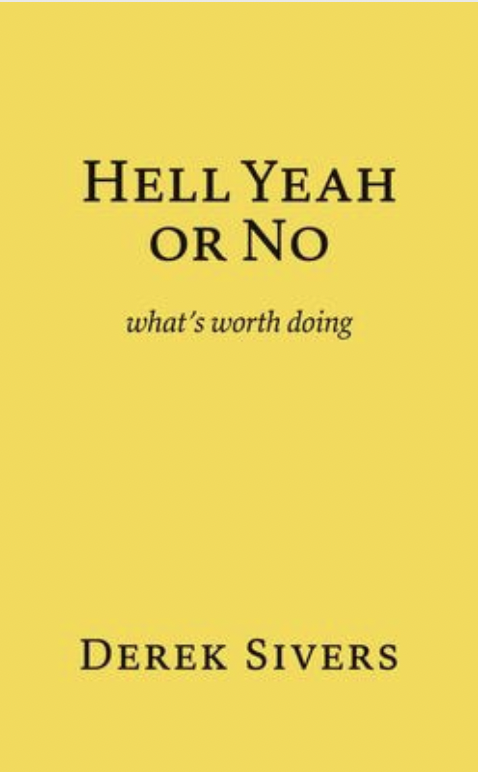
I’ll credit Derek Sivers, though I've heard his book title before. Book image of "Hell Yeah or No" by Derek Sivers.
There's a pithy phrase that I keep in mind when outside requests come in:
if it's not a "hell yes," it's a no
I used to say yes to too many things that were just nice ideas. Good things. Worthy things. But not the things I really long for.
For me, over the last few years, songwriting has climbed above almost everything else. Not because I have grand ambitions about touring or rock stardom. It's simply because I love it, and I've denied it to myself for so long.
I love the connections songwriting creates and what I learn about myself in a way that nothing else touches.
Drumming? Yes, I love that too but I turn down gigs now most of the time to focus on my passion for songwriting. I’ve also cut out a lot of TV/Binge show watching and social media time.
I also want to remind you and myself to be self-compassionate. I don’t always make the decision that fits perfectly into my goals, but I am far more clear about where I spend my time and what I can say “Hell Yes” to.
Clarity is a rare commodity worth pursuing.
The Grief Part (The Part Nobody Talks About)
Here's the thing Gary and I both acknowledged: there's a grief in this.
Life is finite. You can't do everything. As we say yes to one thing (and no to a thousand others), we say goodbye to some of the joy or satisfaction we once dreamed of. We are trading up… but it still hurts.
The older we get, the more that lands differently.
It’s important to acknowledge the grief. Take some precious time to let go of things that mean less to you.
In time, you’ll feel the power of your renewed focus and intention pulling you forward with even more resolve than before.
When you stop pretending you'll get to everything, you start protecting what matters most.
It's a lifelong practice. I'm still in it. Gary's still in it. My guess is you are too.
One Last Thing
Gary ended his reply with something that stuck with me:
"There are too many things I really do feel a genuine hell yes for!"
That's actually a beautiful problem to have.
The work isn't to be more productive or to manufacture more time.
It's to keep getting clearer about what deserves the time you already have. This is a constant tending of the garden of our possibilities. We have to keep weeding, pruning and most importantly watering what we want to grow.
If this resonated, I'd love to hear your version of it. What's the thing that keeps not getting done — and what do you think is actually in the way?